
 English

Lista de Projetos
Esta é a lista de projetos disponíveis no sistema. Para saber mais detalhes sobre um projeto clique no seu nome ou imagem. Também pode procurar por um determinado projeto na caixa de pesquisa em baixo.
Página 341
INOCOP - InoCoP - Inovação e Melhoria da Performance no Cluster Automóvel, 2004/EQUAL/A2/AD/235 (P. Ramos)
Informação do Projeto
2004-01-01
2005-12-31
Parceiros do Projeto
MediaNet, is a key and the largest FP6 Networked Audio-Visual Systems and Home Platforms – NAVSHP IP project, which addresses the domain of digital multimedia personal communication and content distribution for residential markets, as well as cooperation schemes between content owners, service providers, network access operators, and telecommunication, computer, components and consumer electronics industries. The objective is to remove the obstacles in Europe to end-to-end digital communications and content exchange, from content/service providers to customers and between persons, over shared broadband access and home network infrastructures, while protecting at the same time suppliers’ and customers’ investments, content owners’ rights, assuring a fair revenues sharing to the stakeholders of the value chain, as well as permitting the necessary regulation actions. The MEDIANET open architecture model enable the deployment of a plethora of different multimedia services from different suppliers over common access and home networks. It will develop enabling technologies, equipment, architectures, services as well as related standards, business models and good practices, addressing content distribution and access services, access/home interworking at the gateway, common home networking, distributed media storage systems, multimedia terminal platforms, common content protection approaches with different digital rights management systems. Advanced coding/decoding circuits based on the latest standards will enable HQ audio-video distribution over wireless connections.
More info at the European Comission website here.
Informação do Projeto
2004-01-01
2006-12-31
Parceiros do Projeto
- ISTAR-Iscte
- THOMSON - Líder (França)
NTERREG III B « ATLANTIC AREA », PIMHAI, “Multispectral and hyperspectral imagery analysis from acquisition to decision, making and expertise in environment management” (2004-2007)
The objective of this project is to provide the industrial sector and the political/institutional decision-makers of the Atlantic area with an operational system including the acquisition and the analysis of aerial EO remote sensing images. This system will be devoted to the interpretation of information and the help in decision-making, to face the important environmental problems in their region. This system will be open and will integrate the recent and future developments of research in multisource/multicomponent imagery.
More Information at the website here
Informação do Projeto
2004-01-01
2005-12-31
Parceiros do Projeto
- ADETTI-IUL - Coordenador Técnico
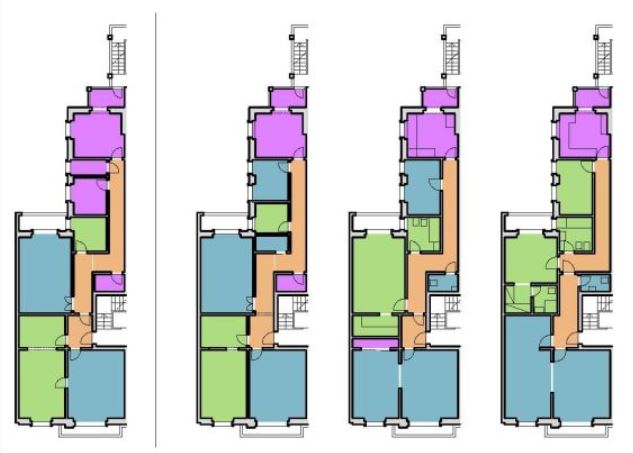
The future of the real estate market in Europe requires the rehabilitation of existing residential areas in order to respond to new life-styles and dwelling requirements.
In this research both shape grammar and space syntax are used as part of a rehabilitation methodology as tools to identify and encode the principles and rules behind the adaptation of existing houses to new requirements. (Eloy, 2012) In addition to defining a general methodology applicable to all the building types, the study focused on a specific type, called “rabo-de-bacalhau” (“cod-tail”), built in Lisbon between 1945 and 1965 for which a specific methodology was generated.
Ongoing work focuses on the generalization of the transformation grammar using the same general framework of rules and integrating specificities of different building types (Eloy and Duarte, 2012), the development of tools to generate functional programmes (Pedroso et al, 2014) and the development of tools to automate the design layouts (Strobbe et al, 2016). The development of a general transformation grammar would enable the rehabilitation of various types of housing buildings.
An architectural challenge, such as the large-scale refurbishment of existent housing stocks, that require too much design efforts to be logistically or economically feasible, can be addressed by a stand-alone generative system such as shape grammars. Considering of design solutions achieve by the transformation grammar, there is evidence that those refurbishment designs have the same architectural quality as designs done by human architects (Eloy and Vermaas 2014b). This design tool could be made available as a web tool directly to the apartment inhabitants and therefore enabling them to define their own house (Eloy and Vermaas 2014a).
Recent work focus on the transformations performed by inhabitants in existing housing settlements and how can shape grammar can be a tool to both assure design quality and enable co-design (Eloy, Dias, Vermaas, 20...
Informação do Projeto
2004-01-01
2019-12-31
Parceiros do Projeto
- ISTAR-Iscte (DLS)
- Ghent - (Bélgica)
- Delft - (Países Baixos (Holanda))
FP6 IST STREP WCAM, “Wireless Cameras and Audio-visual Seamless Networking” (2004-2006)
The WCAM project study, develop and validate a wireless (WLAN) seamless and secured end-to- end networked audio-visual system focused on the technology convergence between video surveillance and multimedia distribution over the Internet. It takes into account real time aspects as well as security and scalability. The project improves state of the art technologies in each of the technological components involved in the system and combine them. The WCAM system is installed and tested with users of both multimedia distribution and video surveillance communities. Recent progresses in flexible bit streams representation of video including Region-of-lnterest (ROI) have led to new standardisation efforts in the frame of JPEG-2000.
WCAM pursues and enforces these works, integrating concerns like wireless, security, and annotations obtained by high-level analysis. WCAM delivery scenario includes both JPEG-2000 and MPEG-4 AVC platforms, which requires also addressing the efficient and seamless transcoding between these two recent standards.
The WCAM platform includes the following key modules: – Camera video encoding incorporating scene analysis, object tracking and adaptive and efficient video coding – Automatic detection of events through scene analysis – Scalable access to video content through transcoding and Scalable Video Coding of MPEG – Multimedia storage and distribution – Wireless networking for local connectivity (WLAN) – Security, both at the network and content levels – Metadata driven access to content
The technologies and systems developed within WCAM are validated during two trials: – the first trial takes place in Annecy (France) during the festival of animated movies in 2005 – the second trial is done in a video surveillance site and demonstrates the ability to operate a video surveillance platform on a wireless network.
More info at the European Comission website he...
Informação do Projeto
2004-01-01
2006-11-30
Parceiros do Projeto
Página 341
