Português

The project emerges from the need to reassess the growing disconnect between human habitats and the natural world, a multifaceted issue in contemporary society demanding mitigation. The abandonment of permaculture practices, limited access to organic foods, rural exodus, and the consequent depopulation of these areas, increasing susceptibility to wildfires, are symptoms of the disrupted relationship between humans and the complex nature of ecosystems. This project aims to reverse this trend through an innovative approach that combines the promotion of biomes (ecosystems sharing common characteristics like climate, vegetation, and fauna), bio-construction, and collaborative robotics for constructing regenerative and resilient buildings.
This project proposes developing software capable of generating adaptable and generative architectural models for creating buildings integrated into biomes. Based on advanced programming and modeling, robotics, local materials, and vernacular architecture, the system aims to integrate buildings into the natural context, maximizing energy efficiency and promoting biodiversity.
Advanced Computational Modeling: Through generative algorithms, the system considers complex variables such as microclimate, topography, geology, and local biodiversity, optimizing design in real-time using artificial intelligence. This approach maximizes structural and energy efficiency while harmoniously integrating the construction into the landscape.
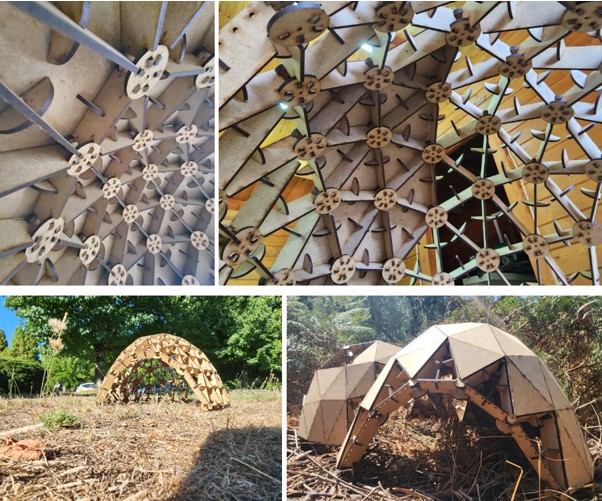
Robotics and Biocompatible Materials: Cutting-edge robotics, utilizing robotic arms and CNCs, is poised to revolutionize construction by automating the creation and assembly of molds that will support biomass, which will also be managed by collaborative robotic systems in the future. The structural strategy relies on compression-only loads, allowing the incorporation of substantial layers of substrate and living matter onto the structures, creating complex ecosystems and promoting biodiversity. This process will primarily employ natural, low-impact materials like wood fiber panels or recycled materials such as polymer panels and plant residues. The developed construction techniques allow the integration of living systems, such as green roofs and walls, promoting biodiversity and the quality of life of the inhabitants.
Vernacular Architecture and Sustainability: The project draws inspiration from ancestral construction techniques and morphologies based on material compression, adapting them to current needs and integrating them into the landscape. Prioritizing natural, renewable, and/or recycled materials minimizes the environmental impact of construction. Energy efficiency is maximized by optimizing thermal insulation and thermal inertia, informed by the local climate and available biomass, reducing reliance on heating and cooling systems, which are designed with the smallest possible ecological footprint. This thermal inertia strategy has global applicability, adaptable to diverse climates and cultures. Preliminary studies show promising results in maximizing the energy efficiency of these constructions, paving the way for innovative, low-cost solutions.
Simulation, Validation, and Prototyping The project employs advanced computational simulations to evaluate the structural, thermal, and energy performance of buildings, ensuring safety and system optimization. Concurrently, in-depth simulations and studies analyze the interaction between architecture and local ecosystems to promote biodiversity and habitat restoration, contributing to the creation of habitable and resilient ecosystems. Preliminary studies suggest technical and structural viability, ensuring practical application and system scalability through optimized construction processes that integrate collaborative robotics and artificial intelligence. Beyond computational simulation, the project envisions generating various reduced-scale physical prototypes, monitored with sensors, which will be provided to NGOs to be used as shelters for rescued domestic animals.
Board of Consultants:
Consultores e membros Externos:
Igor Lacroix, Faculdade de Arquitetura e Urbanismo da Universidade de São Paulo
Gonçalo Lencastre Torres de Castro Henriques, Universidade Federal do Rio de Janeiro
Effimia Giannopoulou, Universitat Internacional de Catalunya, UIC Barcelona
Pablo Baquero, ESARQ, Universitat Internacional de Catalunya, UIC Barcelona /King Abdullah University of Science and Technology Jeddah, Saudi Arabia
The project aims to establish a new model for constructing sustainable, resilient, and nature-integrated buildings. Combining cutting-edge technology with traditional knowledge, the goal is to create spaces that promote human well-being and healthy biomes. More than constructing buildings, the project seeks to create habitable ecosystems where architecture acts as a catalyst for environmental regeneration, contributing to the sustainability and balance of human habitats.
| Research Centre | Research Group | Role in Project | Begin Date | End Date |
|---|---|---|---|---|
| ISTAR-Iscte | Digital Living Spaces | Partner | 2025-11-01 | 2027-04-30 |
| Institution | Country | Role in Project | Begin Date | End Date |
|---|---|---|---|---|
| Faculty of Architecture and Urbanism of the University of São Paulo (FAUUSP) | Brazil | Partner | 2025-11-01 | 2027-04-30 |
| Name | Affiliation | Role in Project | Begin Date | End Date |
|---|---|---|---|---|
| Mauro Costa Couceiro | Integrated Researcher (ISTAR-Iscte); | Principal Researcher | 2025-11-01 | 2027-04-30 |
| Ricardo Pontes Resende | Professor Associado (DTDA); Integrated Researcher (ISTAR-Iscte); | Researcher | 2025-11-01 | 2027-04-30 |
| Leonor Domingos | Professora Auxiliar (DTDA); Integrated Researcher (ISTAR-Iscte); | Researcher | 2025-11-01 | 2027-04-30 |
| Nuno Silva | Professor Auxiliar Convidado (DCSE); Associate Researcher (ISTAR-Iscte); | Researcher | 2025-11-01 | 2027-04-30 |
| Simão Lopes | Research Assistant (ISTAR-Iscte); | Researcher | 2026-06-04 | 2028-08-22 |
| Reference/Code | Funding DOI | Funding Type | Funding Program | Funding Amount (Global) | Funding Amount (Local) | Begin Date | End Date |
|---|---|---|---|---|---|---|---|
| 2024.17482.PEX | -- | Contract | FCT - PTDC.PEX - Portugal | 59962.50 | 59962.50 | 2026-02-23 | 2028-08-22 |
No records found.
No records found.
| Title | News Media Entity | Type | Publication Date |
|---|---|---|---|
| Noite Europeia dos Investigadores - Direto | RTP | Interview | 2025-09-27 |
No records found.
No records found.
With the objective to increase the research activity directed towards the achievement of the United Nations 2030 Sustainable Development Goals, the possibility of associating scientific projects with the Sustainable Development Goals is now available in Ciência_Iscte. These are the Sustainable Development Goals identified for this project. For more detailed information on the Sustainable Development Goals, click here.