
 English

Tecnologias de reconhecimento facial. Etho-Assemblages e futuros alternativos
Investigador
As tecnologias de reconhecimento facial recolhem biliões de rostos que são armazenados para múltiplas utilizações, desde a identificação e o rastreio de indivíduos, até ao treino de redes neuronais profundas - o pilar da inteligência artificial (IA) moderna. Desde a etiquetagem de uma fotografia nas redes sociais ou o desbloqueio de um computador até às aplicações controversas do reconhecimento facial em espaços públicos, escolas, locais de trabalho e atividades de aplicação da lei, as tecnologias de processamento facial entraram em quase todos os aspetos das nossas vidas. Embora os benefícios esperados estejam relacionados com a segurança e a proteção, os críticos sublinham que estas tecnologias normalizam a vigilância e fragilizam a privacidade, exacerbam a discriminação e contêm falhas e imprecisões insuperáveis. O projeto fAIces pergunta: O que importa nas tecnologias de reconhecimento facial e porquê? Como é que atribuir importância acarreta diversas formas de implicação? Que formas de cidadania e de envolvimento público são afetadas? Como emergem escolhas éticas múltiplas e complexas? Este estudo desenvolve uma metodologia inovadora através da qual são tidas em consideração as perspetivas de grupos sociais que nunca foram estudados em conjunto e que estão implicados de forma conjunta mas antagónica nas tecnologias de reconhecimento facial: cientistas que realizam investigação sobre reconhecimento facial; profissionais que trabalham em start-ups e empresas de tecnologia; organizações de proteção de direitos digitais e activistas; comunidades negras; e artistas que incorporam o reconhecimento facial no seu trabalho. O projeto fAIces produzirá uma teoria social inovadora do rosto através da combinação de uma nova abordagem concetual - “etho-assemblages”, que transgride a ideia de princípios éticos fixos e dicotómicos pré-definidos - e a produção de dados empíricos originais. Os principais resultados assentam na expansão da ética e na imaginação de futuros alterna...
Informação do Projeto
2025-03-01
2030-02-28
Parceiros do Projeto
- CIES-Iscte - Líder
- UMinho - (Portugal)
Educação Doutoral em Portugal: Que Futuro?
Investigador
A educação doutoral tem sido palco de mudança em Portugal. Os programas de doutoramento têm sofrido mudanças estruturais e institucionais, resultando em novos e diversificados desenhos educativos e de investigação. Alguns dos debates mais proeminentes em torno destas mudanças recentes debruçam-se sobre programas concebidos à medida de indivíduos versus cursos obrigatórios e previamente estruturados; competências básicas de investigação versus competências transferíveis; duração do grau e prazos de conclusão esperados; diferentes formas de apoio financeiro; práticas e programas de apoio inovadores; tipos de orientação académica e oportunidades de formação; e o impacto da digitalização. Outras tendências incluem a expansão de parcerias de colaboração e intercâmbios internacionais tais como parcerias universidade-indústria, cooperação com outros setores da sociedade e associações internacionais entre universidades similares. No centro destas mudanças estão as motivações, experiências, propósitos e aproveitamento dos alunos. Ligadas aos propósitos e aproveitamento dos alunos, estão as avaliações de qualidade e acreditação, tais como objetivos e fins educativos, importância e relevância do programa e rankings universitários, bem como a futura direção da universidade, considerando a educação doutoral no resto do mundo.
Informação do Projeto
2022-06-03
2024-06-30
Parceiros do Projeto
Towards sustainable, equalitarian, and society-driven research practices and agendas
Coordenador Global
Knowledge creation is at a sustainability crossroad. This is evidenced by a global decline in research breakthroughs despite increasing production of scientific publications. To promote a sustainable development of science, it has become important to diagnose the underlying causes of this paradox, and through this, promote policies which encourage a process of knowledge advancement that is sustainable and fosters public participation in science and technology to better tackle contemporary societal challenges.
This project focus on the analysis of individual research agendas of researchers in academic and non-academic settings, identifying the course they are taking, the factors influencing them, and how to encourage agendas aligned with current global sustainable development goals. This will begin with the analysis of identified issues, such as the effects of the publish-or-perish paradigm, and the gender gap in science, associated with an analysis of macro-economic, social, and cultural dimensions at a country level. Particular focus will be given to identifying the determinants of agendas which tackle societal challenges, and those which promote public engagement and participation, as these are the ones which directly focus on critical challenges such as climate change and assist in bringing science to the service of populations.
The study will make use of an already available dataset of 21.016 researchers from 165 countries and all fields of science, containing career and bibliometric data, information regarding their research agendas, organizational context, and other individual-level information. The dataset will be linked with the Varieties of Democracy (V-DEM) dataset, which contains 450 macro-economic, social, and cultural indicators, arrayed longitudinally, for 202 countries. This will allow for a systemic analysis of the determinants of research agendas, from the macro-level to the micro-level. Knowing what leads researchers to pursue society-driven a...
Informação do Projeto
2022-06-01
2028-05-31
Parceiros do Projeto
Envolvimento do Público em Ciência e Tecnologia por Organizações Académicas
Investigador
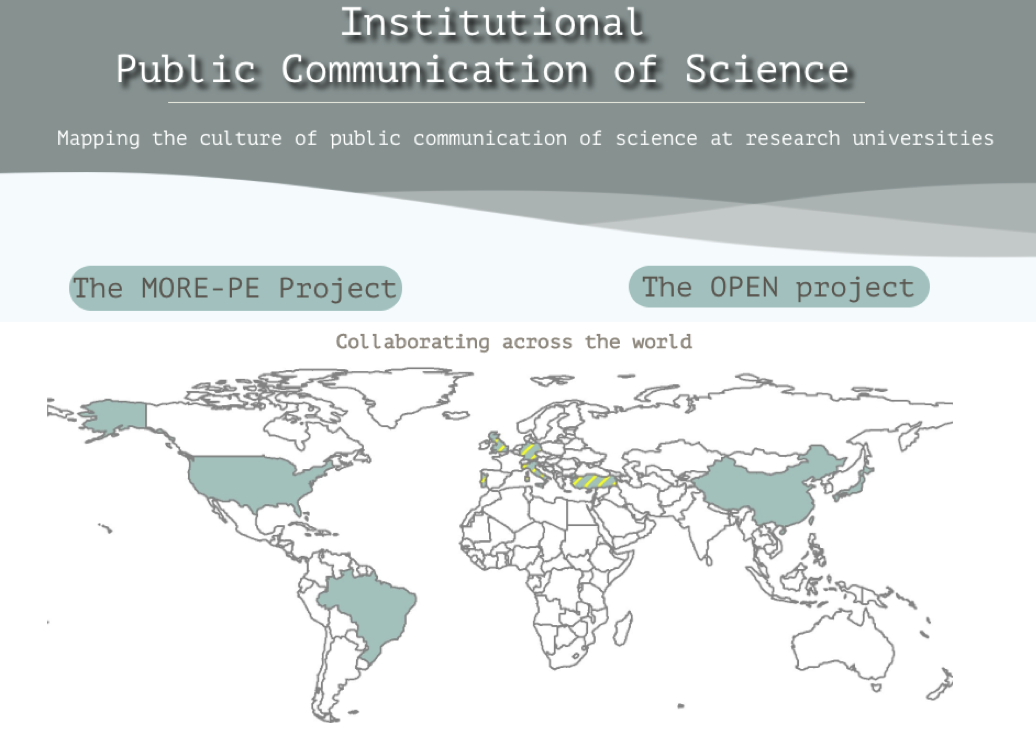
O Envolvimento do Público (EP) em C&T tem-se tornado uma atividade crucial para as organizações académicas e de pesquisa. Apesar de a comunicação entre académicos, universidades e o público não ser algo de novo, ganha contornos de urgência num mundo de ciência global e de concorrência entre as universidades por alunos, staff e financiamento. Isto, juntamente com a expectativa, pela parte do Estado e financiadores, de que a investigação aborde os problemas económicos e sociais, resultou em pressão acrescida sobre a demonstração do impacto da investigação na sociedade. A investigação sobre atividades de EP tem-se centrado em cientistas, sendo insuficiente sobre as estruturas institucionais de comunicação de ciência. Mais, não existem dados comparáveis que permitam uma compreensão plena da realidade da comunicação institucional. Isto torna urgente compreender as estruturas de comunicação e as suas funcoes, sendo de crer que esta investigação terá um forte impacto na academia e na definição de políticas. O projecto proposto 'OPEN' - Organisational Public ENgagement (2018-2021) pretende suprir esta necessidade. O estudo sera conduzido em instituições em Portugal, Reino Unido, Itália e Alemanha para mapeamento de praticas. A equipa reúne peritos em inquéritos alargados e com conhecimento do contexto local para a inquirição em cada país. Será o primeiro trabalho empírico deste género, tendo ainda impactos a nível político, institucional e societal, com produção de informação útil para instituições e governos para criação de políticas e práticas para um melhor envolvimento da sociedade na pesquisa.
O projecto é coordenado pela investigadora Marta Entradas (PI), e financiado pela agencia nacional Fundacao para a Ciencia e Tecnologia (240.000 euros) (Ref: PPTDC/COM-OUT/30022/2017).
Informação do Projeto
2018-11-16
2022-10-03
Parceiros do Projeto
- CIES-Iscte - Coordenador
- LSE - (Reino Unido)
- HHU - (Alemanha)
- UniTrento - (Itália)
- Observa - (Itália)
- Istanbul Bilgi University - (Turquia)
