
 English

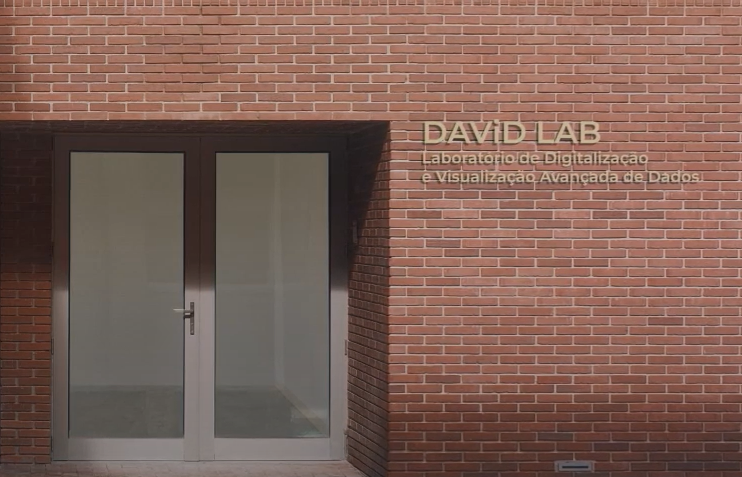
LABORATÓRIO DE DIGITALIZAÇÃO E VISUALIZAÇÃO AVANÇADA DE DADOS (DAViDLab)
Coordenador Global
Criação de um Laboratório de Digitalização e Visualização Avançada de Dados (DAViD Lab), uma infraestrutura única no contexto nacional e regional, que se enquadra na prioridade de investimento 1A - Competitividade e Inovação do Aviso Lisboa2030-2024-36. o DAViD Lab permitirá a igitalização multidimensional de arquivos históricos, culturais e científicos de elevado valor patrimonial, promovendo a preservação e acessibilidade de documentos e objetos. Esta infraestrutura será equipada com tecnologias avançadas de digitalização e curadoria de dados, incluindo soluções interativas e colaborativas baseadas em ferramentas digitais e inteligência artificial.
Informação do Projeto
2025-02-25
2027-08-25
Parceiros do Projeto
- Iscte-CI - Líder
- BRU-Iscte - Coordenador Técnico
- CEI-Iscte
- CIES-Iscte
- CIS-Iscte
- DINAMIA'CET-Iscte - Coordenador Técnico
- CRIA-Iscte
- IT-Iscte - Coordenador Técnico
- ISTAR-Iscte - Coordenador Técnico
- IMT - (Portugal)
- CML - (Portugal)
- ICOMOS-PT - (Portugal)
- EPHEMERA - (Portugal)


Centro de Gestão de Dados de Investigação para as Ciências Sociais e Humanas
Coordenador Global
The "Research Data Management Centre for Social Sciences and Humanities" (RDMC-SSH) is an initiative led by Iscte Knowledge and Innovation (Iscte KI). The Centre will focus on establishing an infrastructure for managing research data in the fields of Social Sciences and Humanities (SSH), addressing the specific needs related to data management in these disciplines.
Informação do Projeto
2025-01-01
2025-12-31
Parceiros do Projeto
- Iscte-CI - Líder
Inovação em Sensores e Comunicações para a Sociedade
Investigador
O Instituto de Telecomunicações (IT) em Lisboa pretende unir esforços de equipas que têm habitualmente trabalhado separados, para criar competências abrangentes na área de sensores, principalmente para aplicações biomédicas, e em tecnologias de comunicação para contribuir para a transição digital e ensino superior. Para isso necessita de reequipar laboratórios. Pretende aumentar o potencial para atrair financiamento e estudantes, fixar investigadores, e transferir valor para empresas da AML.A operação apresentada, ComSense - Inovação em Sensores e Comunicações para a Sociedade enquadrada nas Infraestruturas de ciência e tecnologia pelo seu enquadramento na área de formação avançada de alunos, e criação de competências e infraestruturas para atração, desenvolvimento e fixação de investigadores e docentes, quer nacionais, quer internacionais na AML, e capacitação para o mercado de trabalho, insere-se no Domínio de Especialização Transversal – Ensino Superior. Adicionalmente, o tópico dos sensores para aplicações médicas, insere-se no Domínio de Especialização Temática – Saúde.Por outro lado, o tópico das tecnologias para aumento da largura de banda e a capacidade das redes wireless para conetividade de banda ultra larga no 5G e 6G, potenciando novas aplicações e serviços digitais para o grande público, insere-se no Domínio de Especialização Transversal – Transição Digital.
Informação do Projeto
2024-10-01
2027-09-01
Parceiros do Projeto
- IT - Líder (Portugal)
Terahertz Reconfigurable Metasurfaces for ultra-high rate wireless communications
Investigador
The sixth generation (6G) of mobile communications, planned around 2030, is expected to support innovative applications with requirements not met with today’s technologies, such as massive-scale communications (within IoT), the Internet of senses, holographic communications, massive digital twinning and Extreme Reality, full autonomous driving and flying networks, considering use cases in smart cities, smart home and factories (e.g. ultra-high precision 3D positioning). With the emergence of viable THz communications systems on the horizon, it is crucial to contribute THz communication and networking to the technology roadmap for beyond 6G timeframe and a step closer to industrial uptake. The TERRAMETA project aims to investigate revolutionary technologies for 6G and demonstrate the feasibility of Terahertz (THz) Reconfigurable Intelligent Surface (RIS) assisted ultra-high data rate wireless communications networks. Novel high-performance hardware including the THz RIS and THz transmitter/receiver will be developed and advanced network analysis/optimizations techniques will be developed using these real THz components. The proposed TERRAMETA THz network will be driven by 6G usage scenario requirements and indoor, outdoor, and indoor-to-outdoor scenarios will be demonstrated in real factory setting and telecom testing field. It is expected that the outcome of this project will significantly progress innovations for across the 6G Technology and systems.
Informação do Projeto
2023-01-01
2026-01-01
Parceiros do Projeto
- IT-Iscte
- INESC TEC - Líder (Portugal)
- University of Athens - (Grécia)
- University of Hertfordshire - (Portugal)
- University of Oulu - (Portugal)
- Intracom Telecom - (Portugal)
- IT - (Portugal)
Increased Resolution Microwave Imaging using Superlens
Investigador
To study the resolution limitations of microwave imaging applied to biomedical applications.To develop a superlens to improve resolution of microwave imaging in the biomedical context.

Trailblazing Inclusive, Sustainable and Resilient Cities
Investigador
O projecto InCITIES foca-se nas cidades do futuro: resilientes, sustentáveis e inclusivas. Este projecto é financiado pela Comissão Europeia, através do Programa Quadro Horizonte Europa, lançado, no contexto da European Excellence Initiative.
InCITIES promove e desenvolve iniciativas no âmbito da investigação, do ensino e no relacionamento com a sociedade envolvente.
InCITIES reflete os desafios globais europeus para as cidades do futuro abordando quatro objetivos:
Mapear estratégias de transformação institucional para universidades baseadas em investigação, progressivamente mais sustentável, incrementando a ciência aberta e oportunidades de carreira,
Fortalecer uma rede de longo prazo das instituições de ensino superior e de investigação participantes e os ecossistemas circundantes com base em hubs integrados de conhecimento,
Aumentar a capacidade científica, tecnológica e de pessoal, partilhando as melhores práticas pedagógicas, de pesquisa, de gestão e administrativas no consórcio,
Promover as competências digitais, criando uma plataforma de educação aberta e inovadora em sinergia com a agenda de investigação, desenvolvimento e inovação do projecto, com foco nas cidades inclusivas, sustentáveis e resilientes.
Os parceiros do consórcio representam universidades de cinco países (Portugal, Eslováquia, Finlândia, França e Alemanha), que asseguram as competências e os conhecimentos relevantes para a implementação do projecto.
Além do Iscte, o consórcio integra os seguintes parceiros universitários: Universidade de Zilina (Eslováquia), Universidade de Ciências Aplicadas de Colónia (Alemanha), Universidade Gustave Eiffel (França) e Universidade de Ciências Aplicadas Laurea (Finlândia).
Os parceiros associados do projecto são: Área Metropolitana de Lisboa, União das Vilas e Cidades da Eslováquia, Mobilidade Inteligente da Eslováquia, Confederação Portuguesa do Voluntariado, Confederação Portuguesa das Colectividades de Cultura, Recreio e Desport...
Informação do Projeto
2022-10-01
2025-09-30
Parceiros do Projeto
- Iscte - Líder
- TH KOLN - (Alemanha)
- LAUREA - (Finlândia)
- UNI EIFFEL - (França)
- UNIZA - (Eslováquia)
Satellite-based microwave remote sensing for marine litter mapping
Investigador
Man-made marine litter constitutes nowadays a major environmental threat. Most of current studies address optical detection techniques, but these have impairments related to lighting conditions, cloud cover and biofouling. Microwave techniques (MW) do not suffer from the previous limitations, therefore, they are a potential resource for detection of marine floating litter. However, to date, there is no systematic characterization of the MW signature of floating plastic. The objective of the project is to characterize the MW response of floating macroplastic, to find the most favorable MW sensing modality, best frequency bands and, for each one, find the minimum required concentration of the litter and size of the patch for positive detection. The study will consider known active radar imaging and non-imaging techniques as well as passive radiometric techniques. It will include the development or extension of known data processing and analysis methods to favor the detection of plastic litter.
European network for advancing Electromagnetic hyperthermic medical technologies
Coordenador Local
MyWAVE Action takes a holistic approach by bringing together key players in the field of dielectric spectroscopy, translational research, and medical professionals. Conjoining these varied communities into one collaborative network is critical to advance the design, development, and commercialisation of EM hyperthermic technologies, so that they can reach patients faster and improve treatment outcomes.
Informação do Projeto
2019-09-04
2022-09-03
Parceiros do Projeto
Additive Antenna Manufacturing
Coordenador Global
Additive manufacturing, or 3D-printing, is bringing a revolution to most engineering areas. It is not just about changing fabrication processes and materials, but more importantly, enabling powerful new concepts and designs not feasible or affordable with traditional manufacturing. In parallel, personal communications present a meteoric evolution that impregnates each one’s life and habits. This growth will continue embodying concepts like the Internet of Things (IoT) and next generation mobile communications (5G). It will transparently link much more users, machines, sensors and virtual nodes through land and satellite infrastructures. It requires effective low-cost solutions for mass-market. AM will play a role, and antennas are a key player in wireless systems. The project focuses on the development of new antenna concepts benefitting from opportunities offered by AM, aiming at different aspects of IoT, 5G and associated applications, including body-area networks.
Informação do Projeto
2018-06-01
2021-06-01
Parceiros do Projeto

ElectroMagnetic imaging for a novel genERation of medicAL Devices
Coordenador Local
To accelerate translation of research of EM medical imaging into clinical prototypes by advancing the technology, addressing possible standardizing procedures and developing prototypes for novel applications.To set-up and support the first complete scientific and training programme in EM medical imaging at a European Level (and where possible worldwide).To provide the Early Stage Researchers (ESRs) with excellent, multi-disciplinary scientific training and a set of competitive, transferable skills.To expose the ESRs to academic and non-academic sectors, improving their future career perspectives.
Microwave medical imaging
Coordenador Local
Traditional medical imaging technologies are expensive, require large infrastructures, and may bare health risk. Microwaves have appeared as a potential complementary imaging technique, not to replace but to be used as part of early low-cost screening protocols. Microwave imaging (MWI) is particularly relevant for early breast cancer detection, AVC detection or even bone cracks. The advantage of microwaves is the larger contrast of affected tissues when compared to gold standard techniques. The disadvantage is clearly the lower resolution. Following the efforts worldwide to perfect the MWI technique for medical imaging, the objective of the project is to advance on the antenna design to improve resolution and method sensitivity. The project will work towards the development of a lab demonstrator, having in mind future low-cost portable devices to be used in the front-line of massive screening programmes.
Informação do Projeto
2014-09-01
2019-08-01
Parceiros do Projeto
Trapping Light in Open Resonators
Coordenador Local
• Investigate theoretically and experimentally the potentials of new open resonators based on ENZ-type shields at microwaves.• Investigate nonlinear effects. • Extend to electronics our approach of having bound photonic states coupled to the continuum.
Informação do Projeto
2014-04-01
2016-04-01
Parceiros do Projeto

Compact Lens-Based Mechanically Steered Ka-Band user Terminal Antenna
Coordenador Global
The main objective of the project is to develop a compact low-profile lens-based mechanically steered Ka-band antenna for satellite mobile user terminals. It is intended as a single aperture antenna to operate simultaneously in the downlink and uplink bands with circular polarization, the scanning being achieved by in-plane lens translation over a fixed feed. The pros and cons of translating the feed with fixed lens will be also addressed. Besides the feed design, it requires the identification of an adequate lens type, its fabrication technology and its design.
Informação do Projeto
2013-11-01
2018-10-01
Parceiros do Projeto
Development of a European-based Collaborative Network to Accelerate Technological, Clinical and Commercialisation Progress in the Area of Medical Microwave Imaging
Coordenador Local
Informação do Projeto
2013-11-01
2017-11-01
Parceiros do Projeto
Millimeter Wave Antennas for Next-Generation Satellite Mass Services
Coordenador Local
1) Research of new compact Ka-band satellite antenna solutions capable of operating simultaneously in both uplink and downlink bands. The antennas will be based on the aperture overlap concept. In one approach an adequate frequency-selective multi-layer slab is placed above an array of feeds in order to produce multiple overlapping apertures, each one ensuring adequate reflector illumination. In another approach of the project, integrated shaped lens antennas with multiple feeds attached to its base will be explored with the same objectives. 2) Design of compact low-cost Ka-band antennas for terrestrial terminals, either fixed or installed on moving platforms like cars, trains or ships. These antennas must have a single steerable beam constantly pointing towards the satellite as the terminal moves. This will evolve from a previous concept proposed by the project team, where a steerable shaped dielectric lens pivots in front of a stationary feed requiring no rotary joints which are expensive and prone to faults. New lens configurations will be researched, including flat lens made of inhomogeneous metamaterial.
Informação do Projeto
2013-07-01
2016-01-01
Parceiros do Projeto
Thermal Blanket with Low RF Reflectivity
Coordenador Local
The primary objective of this study is to propose a series of concepts based on metamaterials in combination with the typical materials used in thermal blankets in order to reduce the blanket’s RF reflectivity in specific frequency ranges. Concepts will be explored at the C-, Ku, Ka and Q/V bands. The new blankets are required to maintain their thermal and mechanical properties as much as possible and be designed with space flight in mind using space qualified clean-room compatible materials. Further requirements include cost effective fabrication compatibility, and reduced added mass compared to traditional multi-layer blankets.
Informação do Projeto
2012-11-01
2015-11-01
Parceiros do Projeto
Spatially confined RFID detection with a metamaterial grid
Coordenador Local
To use metamaterials to confine the detection of UHF RFID systems to a desired volumetric region of space, and prevent in this manner unwanted detections of nearby tags.
Informação do Projeto
2011-06-01
2012-12-01
Parceiros do Projeto
New Fromtiers im mm/sub-mm waves integrated dielectric focusing systems
Coordenador Local
- Development of advanced analytical and numerical modelling techniques in electromagnetic theory using complementary formulations for the analysis, synthesis and optimisation of integrated dielectric focusing systems- Implementation of powerful computer-aided-design tools- Benchmarking measurement facilities at mm and submmwavelengths- Promotion of research mobility
Non-local Metamaterials and Applications
Coordenador Local
• Design of low-loss materials with anomalous dispersion. • Demonstration of broadband negative refraction a partial focusing using nonlocal metamaterials.• Realization of ultra-subwavelength waveguides.• Realization of absorbing metamaterials with enhanced properties.
Informação do Projeto
2010-01-01
2012-12-01
Parceiros do Projeto
Advanced Antennas for Radio Frequency Identification and Localization
Coordenador Local
1. Extension of previous work from this team on UHF RFID antennas for smart storeware, to replace or complement current optical bar code solutions, with the added value of enabling automation.2. Design of dedicated UHF RFID passive tags for application on specific type of objects to enhance its detection, considering omnidirectionality, size, read range and sensitivity to nearby objects. Commercially available passive chips will be integrated into the developed prototypes.3. Development of antennas for a new generation of ultra wideband impulse radio (IR-UWB) RFID technology at microwaves (3 to 10 GHz). Studies will explore the use of these tags for precise indoor location applications; this includes the development of a demonstration test bed.
Informação do Projeto
2010-01-01
2012-12-01
Parceiros do Projeto
Metamaterial with extreme permittivity
Coordenador Local
Investigate microwave applications for the x-wires metamaterial, such as the realization of ultra-subwavelength waveguides, superlensing, miniaturization of microwave components, or the design of novel resonant inclusions.
Informação do Projeto
2008-12-01
2010-05-01
Parceiros do Projeto
Millimetre-wave wireless indoor link with automatic tracking antenna
Coordenador Local
The objective is to demonstrate a low-cost high bit rate data link that integrates a mechanically steerable lens antenna with a simplified RF front-end and with automatic tracking control system. A fully operational video transmission will be demonstrated with this wireless mobile mm-wave system.
Informação do Projeto
2008-10-01
2010-10-01
Parceiros do Projeto
Network of Excellence in Wireless Communications ++
Coordenador Local
1) Research of new compact Ka-band satellite antenna solutions capable of operating simultaneously in both uplink and downlink bands. The antennas will be based on the aperture overlap concept. In one approach an adequate frequency-selective multi-layer slab is placed above an array of feeds in order to produce multiple overlapping apertures, each one ensuring adequate reflector illumination. In another approach of the project, integrated shaped lens antennas with multiple feeds attached to its base will be explored with the same objectives. 2) Design of compact low-cost Ka-band antennas for terrestrial terminals, either fixed or installed on moving platforms like cars, trains or ships. These antennas must have a single steerable beam constantly pointing towards the satellite as the terminal moves. This will evolve from a previous concept proposed by the project team, where a steerable shaped dielectric lens pivots in front of a stationary feed requiring no rotary joints which are expensive and prone to faults. New lens configurations will be researched, including flat lens made of inhomogeneous metamaterial.
Informação do Projeto
2007-12-01
2010-12-01
Parceiros do Projeto
RFID Smart Surfaces
Coordenador Local
To develop near-field ultra-low-cost UHF RFID antennas for tag reading in self-confined interrogation volumes like shelves, or conveyor belts, without the need for portics, shields or barriers.To implement corresponding solutions that are ready for industrial production and integration into retail stores.
Informação do Projeto
2006-12-01
2011-03-01
Parceiros do Projeto
Benchmarking of Integrated Lens Antenna Design and Manufacturig
Coordenador Local
To benchmark IT and IETR lens design methods, lens analysis and design tools, manufacturing technologies, measurement facilities and results. The output of the project will be used to improve the design and prediction tools that are being developed in both institutes
Informação do Projeto
2006-01-01
2009-12-01
Parceiros do Projeto
- IT-Iscte
- IETR - Univ. Rennes, France - (França)
Reconfigurable Low-profile Antennas Using Metamaterials
Coordenador Local
The aim of the project is to design and theoretically characterize reconfigurable metamaterial surfaces that can be used as ground planes for low-profile antennas, although other relevant applications are anticipated. Tunable elements are incorporated into the surface, such as varactor diodes or micro-electro-mechanical systems (MEMS), to allow that the resonance frequency, as well as the effective response of the surface (i.e. the effective boundarycondition), can be tuned electronically.
Informação do Projeto
2005-10-01
2008-09-30
Parceiros do Projeto
Antenna Centre of Excellence
Coordenador Local
This Network of Excellence is intended to increase the efficiency and relevance of antenna research in Europe. It plans to acheive horizontal integration by selecting, perfecting and regrouping for dissemination of world level courses, documentation, software and test resources.The Joint Research Programme (JRP) will provide vertical integration, fostering university-industry co-operation and focusing research to support Europe’s competitiveness and to limit duplications in 4 key areas:A. Millimetre wave antennas (Integrated, Meta-material based…)B. Small terminal antennas (Miniaturised, using MEMS…)C. Broadband antennasD. Re-configurable antennas.
Informação do Projeto
2004-01-30
2007-12-31
Parceiros do Projeto
Integrated Lens Antenna Shaping
Coordenador Local
Main Objective: ILASH project aimed at developing and delivering to ESA-ESTEC a validated software tool for the design, analysis and optimization of high permittivity circular symmetric integrated lens antennas (ILA) with optimized coupling to incoming broadband on-axis beam, or to narrowband off-axis beams in scanning applications – the ILASH tool. The tool is especially tailored for the design and optimization of mm-wave or sub-mm-wave shaped double-shell lenses that enable the radiation pattern compliance with two simultaneous conditions selected from a predefined list. The experimental validation of the tool is based on scaled lens prototypes operating between 40 GHz and 65 GHz.
Informação do Projeto
2003-09-01
2007-09-01
Parceiros do Projeto
Fiber Solitons: Propagation, Amplification and Switching
Coordenador Local
Main Objective: To study fiber solitons in the following aspects: (i) the in-line control in WDM soliton communication systems; (ii) amplification of solitonlike pulses in erbium-doped fiber amplifiers; (iii) soliton switching in nonlinear fiber couplers; (iv) chiral solitons, i.e., solitons in chiral optical fibers.
Informação do Projeto
2000-10-01
2004-10-01
Parceiros do Projeto
Microwave and optical devices for transmission and switching using linear and nonlinear medi
Coordenador Local
Study,using numerical and analytical methods,of new wave propagation problems in microwave and optical devices using nonlinear and/or complex media.Two main topics are addressed in the project:(i)soliton switching in nonlinear fiber couplers;(ii)electromagnetic wave propagation in 2D and 3D chiral waveguides
Informação do Projeto
1997-05-01
2001-02-21
Parceiros do Projeto
